
 11th, June 2026
Titanium and stainless steel glasses differ mainly in weight, durability, and cost. Titanium is lighter, hypoallergenic, and more corrosion-resistant, while stainless steel is cheaper and easier to repair. Titanium frames suit luxury and sensitive-skin markets; stainless steel fits budget and bulk orders. Beautaste Eyewear, a trusted OEM/ODM partner for mid-to-high-end eyewear brands, has manufactured titanium frames since 2000 and offers both material options.
Metal alloys provide effective and durable glass frame options; however, selecting either titanium or stainless steel glasses is not a result of luck.
There are specific properties of these materials that are better suited for certain consumers and markets. The differences will allow firms to make proper choices when sourcing the metal alloys.
Here you find all the information required to choose the right metal for the frames of your glasses.
The core distinction comes down to composition.
Titanium is a near-pure metal element, while stainless steel is an alloy composed mostly of iron and may contain chromium and sometimes nickel.
This difference influences almost all aspects of performance, including weight and skin tolerance.
The titanium used in making spectacles is normally pure titanium (99% titanium) or beta titanium, where an addition of vanadium and aluminum allows for flexibility.
Additionally, the various stainless steels used in making spectacles include 316L, which is commonly used due to its low nickel composition.
In the comparison of stainless steel vs. titanium eyeglass frames, the grade of the materials is just as important as the type of material.
One of the most distinct features that sets titanium and stainless steel apart is their weight.
The density of titanium is 4.5 g/cm3, while the density of stainless steel is closer to 8.0 g/cm3 – more than twice the density of titanium.
In this respect, titanium frame eyeglasses will put less pressure on your nose bridge and temples during daily wearing.
Stainless steel glasses are comfortable for wearing, but still, some people may feel tired at the end of the day.
Also, beta titanium can slightly bend when you exert pressure on it and then return to its initial position; thus, titanium is more flexible than stainless steel.
Both options are durable in their own way, but they age under different circumstances.
Titanium oxidizes naturally and forms an oxide layer that protects from moisture, sweat, and any other chemical substances.
Hence, this material is appropriate for those who live in areas with high humidity and also engage in physical exercise.
Stainless steel, grade 316L, shows high corrosion resistance.
But if titanium contacts too much salt water and sweat, it may cause deterioration of the surface of lower-grade stainless steel eyeglasses.
There is no nickel in titanium because it is among the most common causes of allergy from wearing metal jewelry and glasses.
Different grades of stainless steel may contain some amount of nickel.
For people with sensitive skin, there is little competition between titanium vs metal glasses frames. Titanium wins on skin compatibility.
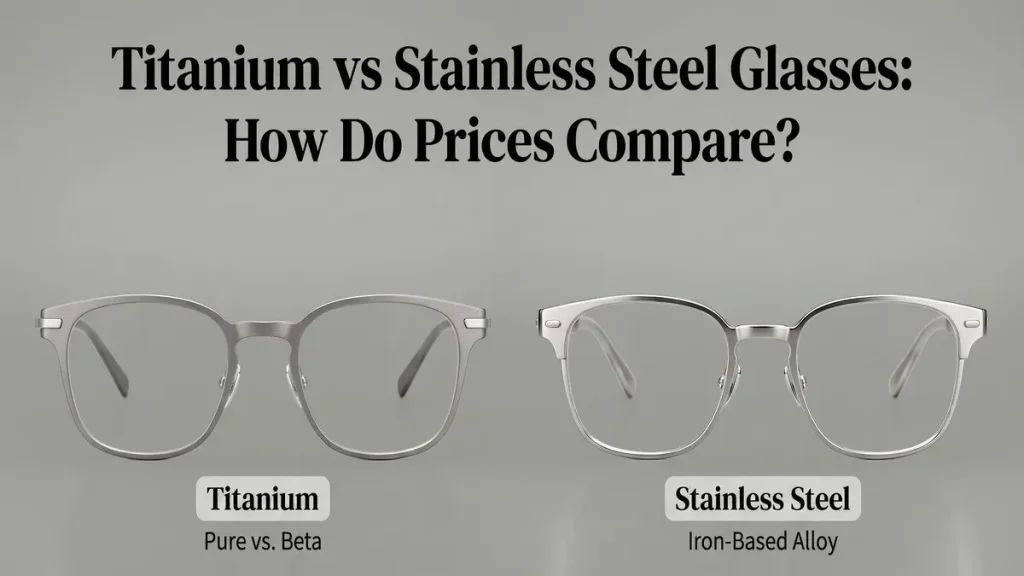
Steel frames are cheaper to manufacture than titanium frames since the material used is cheap. Also, steel is easy to machine and weld using conventional techniques. Steel is therefore a viable choice when manufacturing middle and low-end products.
The cost of producing titanium frames is relatively high compared to steel frames.
It is important to note that pure titanium needs a special welding technique during manufacturing, while beta titanium needs a complex procedure.
Nonetheless, the increased cost is justified in some market segments such as optical, medical grade, and fashion brands.
For wholesale buyers, stainless steel offers a lower minimum investment per unit. Titanium opens the door to higher margins when positioned correctly.
Stainless steel frames are easier to repair. Most optical technicians can adjust and solder stainless steel with standard tools.
Titanium requires argon welding equipment, which not all opticians have on hand. This is worth considering for markets where after-sales servicing matters.
On the other hand, beta titanium’s natural flex reduces the frequency of adjustments needed in the first place. The material adapts slightly to the wearer over time.
The answer lies more in what is expected by the target market rather than what is objectively the better material.
Stainless steel frames are suitable for bulk products, opticals for beginners, and where price is an important consideration.
They are also suitable for brands looking for versatility of design because stainless steel can be molded into more intricate shapes.
Titanium is suitable for luxury optical brands, medical eyewear, and wherever customers are specifically looking for lighter or hypoallergenic frames.
They are also ideal for brands creating long-lasting product lines because titanium frames last longer.
Brands serving more than one market simultaneously will find it easier to source when dealing with a manufacturer producing both types of frames.
Beautaste has been manufacturing titanium frames since 2000 and provides pure titanium and beta titanium frames in addition to stainless steel ones.
Their product range includes PVD colorways, spring and screwless hinge configurations, and CE and FDA certifications backed by SGS material reports.
With facilities in China, Vietnam, and Thailand, their setup supports flexible production across different market requirements.
The comfort factor and skin sensitivity are in favor of titanium. Nevertheless, stainless steel is cheaper and easier to repair than titanium. Therefore, the answer to the question depends on personal choice.
They are durable when using the 316L grade. Nevertheless, they have higher risks of surface corrosion in case of humid conditions comparing to titanium frames and are more heavy.
There are certain stainless steel grades that contain some amount of nickel, which can trigger an allergic reaction. In order to avoid that, it is necessary to select low-nickel grades or pure stainless steel frames.
Stainless steel frames are significantly easier to repair because there are no special conditions required (argon welding). Consequently, titanium is more difficult to repair.
Yes, titanium is more expensive not only because it is a rare material but also due to the complicated manufacturing process.

+86-577-86072133

0086 13506515296

 English
 Spanish
 Arabic
 French
 Russian
 Portuguese
 German
 Japanese
 Korean
 Hindi
 Bengali
 Italian
 Turkish
 Persian
 Vietnamese
 Thai
 Urdu
 Dutch
 Indonesian
 Greek
 Swedish
 Malay
 Polish
 Czech
 Tagalog
 Danish







 China
 LIBERIA
 FRANCE
 BARBADOS
 KIRIBATI


