
 13th, August 2026
Selecting the best running sunglasses for marathon training requires lightweight frames, UV400 lenses, secure fit, and effective ventilation. During long-distance runs, stable frames and clear lenses help prevent fogging, glare, and repeated adjustments that can distract runners and reduce comfort.
Finding sports frames made of quality materials that are hydrophilic and have good construction can help avoid some of the typical failures experienced on the field. Running sunglasses tend to perform better than conventional fashion frames due to vibration, sweating, wind, and sustained use.
Squinting through persistent stimulation results in fatigue. This is because of constant exposure to bright light, horizontal glare, and wind, causing eye strain.
The movements in a runner’s gait create constant vibration in the frames. Sports frames provide stability for proper alignment.
Sourcing sports eyewear requires evaluating metrics for impact resistance and active ventilation. ISO 12312-3 specifies requirements for sunglasses used for running, cycling, and similar active lifestyles, including protection from solar radiation, wind, dust, and rain. For markets requiring certified protective eyewear, specify the appropriate applicable standard rather than treating CE marking alone as the safety specification.
To prevent fogging, strategic lens venting holes facilitate continuous aerodynamic airflow behind the shield. Below is a technical comparison of relative impact resistance across lens materials.
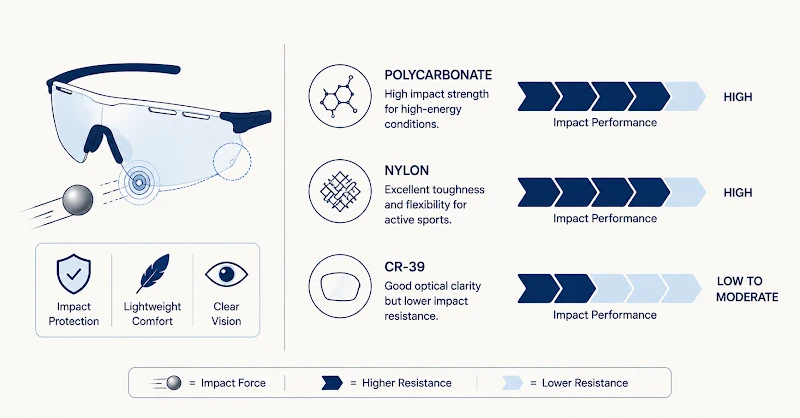
| Lens Material | Impact Resistance | Weight / Performance | Best Use for Running Sunglasses | B2B Buying Consideration |
|---|---|---|---|---|
| Polycarbonate | High | Lightweight | Marathon, road running, high-impact environments | Strong choice when impact protection and low weight are priorities |
| Nylon | High | Lightweight and flexible | Long-distance and performance eyewear | Suitable for brands prioritizing durability, optical performance, and lightweight construction |
| CR-39 | Moderate to Low | Lightweight but less impact-resistant | Casual or lower-impact eyewear | Consider only when impact resistance is not the primary requirement |
Selecting lens colors is an operational process based on ambient UV exposure. Sourcing the correct color profile maintains high visibility regardless of lighting shifts.
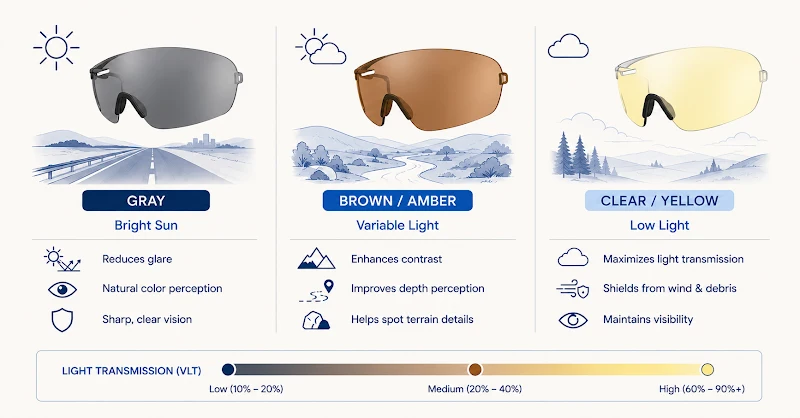
Opting for polarized running sunglasses with gray lenses blocks bright glare on open roads. They reduce light transmission uniformly to preserve natural color perception.
Brown and amber lens tints enhance depth perception on mixed-terrain paths. These specialized tints can enhance contrast in variable-light conditions, helping runners distinguish surface details and potential hazards.
Clear or yellow lenses maximize light transmission under heavy cloud cover. They shield eyes from wind and debris without darkening the view.
A frequent troubleshooting scenario involves correcting frame slip during high-perspiration runs. Standard plastic nose bridges lose adhesion when wet, whereas hydrophilic rubber grips increase friction as moisture rises.
In addition, standard metal screw-hinges represent a common hidden failure point under running vibrations. Vibrational stress causes loose screws to back out, requiring screwless hinge configurations or custom thread treatments to prevent on-field mechanical failures.
Wraparound shields provide lateral wind protection and unobstructed vision. Specifying premium lightweight running sunglasses made from TR90 polyamide eliminates headaches during long runs.
Adjustable nose arms allow custom face-clearance to optimize lens ventilation. Hydrophilic grips keep frames anchored to the face during heavy sweat.
Sourcing prescription-compatible designs is crucial for runners requiring vision correction. Sourcing designs like the Beautaste Horizon provides a reliable platform for RX inserts.
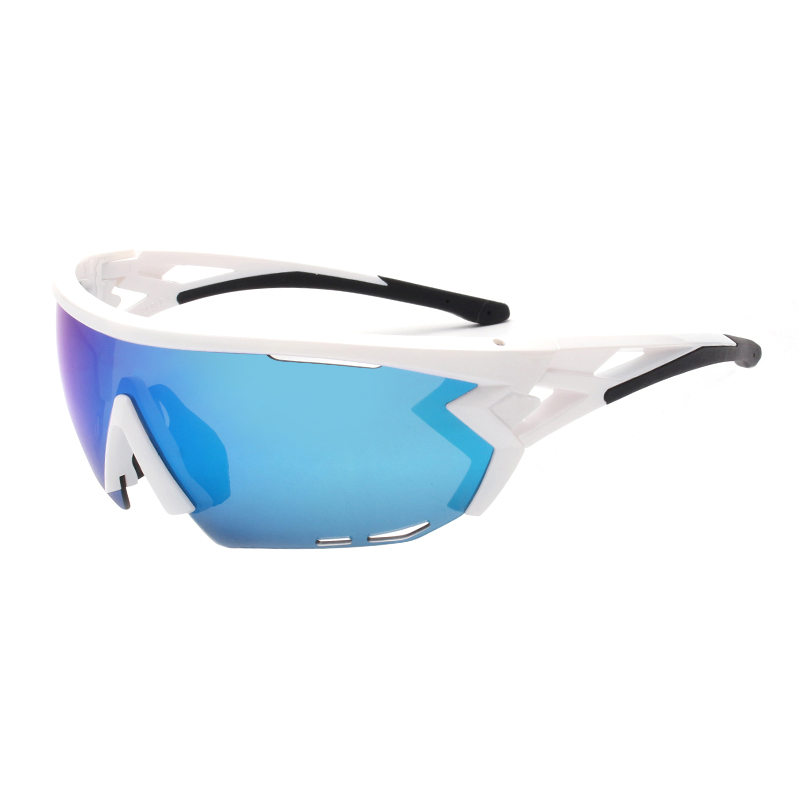
Designing active eyewear lines requires balancing aesthetics with material engineering and logistics. Brands must select durable materials that resist sweat and chemical degradation.
Distributing production across China, Vietnam, and Thailand can give brands greater sourcing flexibility. This strategy reduces operational dependence on a single manufacturing location.
For marathon training and long-distance running, brands should prioritize running sunglasses that combine lightweight construction, secure fit, durable materials, effective lens protection, and performance-focused design. Choosing the right frame and lens specifications helps reduce distractions from glare, wind, sweat, and frame movement during extended runs.
Beautaste offers scalable manufacturing with TR90 and pure titanium frame options for active eyewear collections. Brands can source durable, lightweight designs suited to endurance running and customize their product lines through custom running glasses manufacturing.
Yes, polarized lenses are highly effective at neutralizing horizontal reflective glare from asphalt surfaces to reduce ocular strain. Sourcing durable running sunglasses directly optimizes inventory turnaround, ensuring long-term operational reliability.
Marathon runners select wrap-style TR90 polyamide frames with hydrophilic rubber nose grips for secure, lightweight comfort. These provide the ideal running sunglasses for marathon training, where gear adjustment costs valuable race seconds.
Prevent bouncing by utilizing high-performance sport frames with adjustable hydrophilic rubber nose bridges. These grips allow custom face clearance to optimize active lens ventilation and mechanical stability.

+86-577-86072133

0086 13506515296

 English
 Spanish
 Arabic
 French
 Russian
 Portuguese
 German
 Japanese
 Korean
 Hindi
 Bengali
 Italian
 Turkish
 Persian
 Vietnamese
 Thai
 Urdu
 Dutch
 Indonesian
 Greek
 Swedish
 Malay
 Polish
 Czech
 Tagalog
 Danish






 China
 LIBERIA
 FRANCE
 BARBADOS
 KIRIBATI


