
 21st, August 2026
Kids sunglasses should provide three core qualities: effective UV protection, impact-safe materials, and a secure, age-appropriate fit. For brands, buyers should verify UV-transmittance performance, lens and frame safety, optical alignment, frame dimensions, and applicable compliance documentation for the target market.
The quality control aspects that buyers should consider prior to bulk packaging include temple tension, hinge alignment, nose-bridge fit, and manufacturing uniformity.
Why the Kids Sunglasses Market Is Growing
Parents are altering their purchasing behavior towards eye protection for children to protect from radiation effects. The retailers need to stock up on the top kids sunglasses to meet this demand as this is a high-volume market driven by yearly physical growth.
Sourcing high-durability materials ensures your brand remains competitive in active-lifestyle channels. Proactive inventory planning before peak summer seasons prevents stockouts.
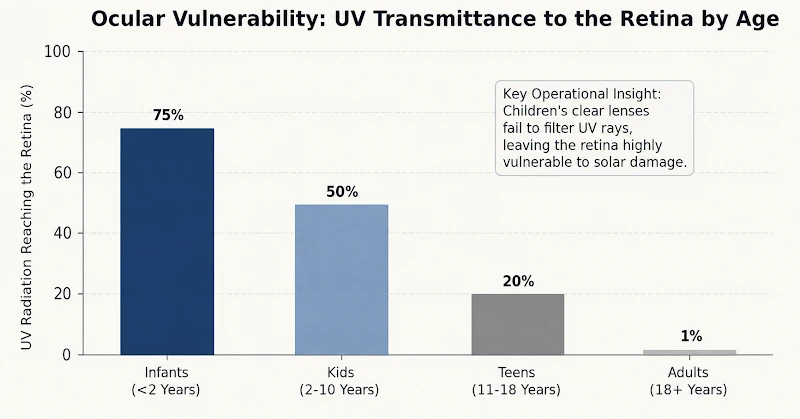
Children are biologically vulnerable because clearer crystalline lenses allow solar radiation to reach the retina. Brands must source products with verified kids sunglasses UV protection that meets the applicable UV-transmittance requirements for the target market.
We use spectrophotometric testing to verify lens transmittance and UV-protection performance before mass production. Factory quality systems can support consistent production, but buyers should separately verify the applicable CE requirements for the target market and FDA requirements where applicable.
Procurement managers must learn how to choose kids sunglasses by auditing frame dimensions and nose bridge ergonomics. Proper temple alignment ensures non-slip, comfortable wear that children will not remove.
Poorly designed nose bridges cause slippage, representing a major hidden failure point in children’s eyewear. Our design team resolves this by integrating soft-touch rubberized nose pads for secure fit.
Selecting lens materials is a critical engineering decision dictating impact safety and optical clarity. While glass is generally less suitable for active children’s eyewear, durable kids sunglasses commonly use polycarbonate because it offers high impact resistance.
A major troubleshooting nuance involves correcting off-center lenses that cause severe optical distortion and eye strain. We resolve this using precision injection molds that align the optical center with the child’s pupil.
| Material Type | Impact Resistance | Optical Clarity | Wholesale Consideration |
|---|---|---|---|
| Polycarbonate | High | High | Strong choice for active children’s eyewear |
| Polyamide (Nylon) | High | High | Flexible option for active-use frames |
| CR-39 / Acrylic | Moderate | High | Consider according to product design and market requirements |
Standard tinted lenses reduce brightness, while kids polarized sunglasses can additionally reduce reflected glare from wet roads, water, and other reflective surfaces. During lens manufacturing and assembly, the polarizing filter must be correctly aligned and securely laminated to maintain optical performance and prevent delamination.
Mirrored coatings use vacuum deposition to apply reflective metal layers that reduce blinding solar glare. Colorful finishes increase overall aesthetic appeal, encouraging consistent wear and driving repeat retail sales.
Prescription-ready frames allow eyewear brands to serve a highly profitable, specialized demographic. Prescription-ready frames should provide adequate lens-groove depth and structural support for the intended prescription range, with lens thickness and frame compatibility verified during fitting.
Managing global procurement requires auditing the factory’s technical tooling, raw materials, and assembly lines. This strict discipline protects retail margins and guarantees consistent product quality across high-volume ocean shipments.
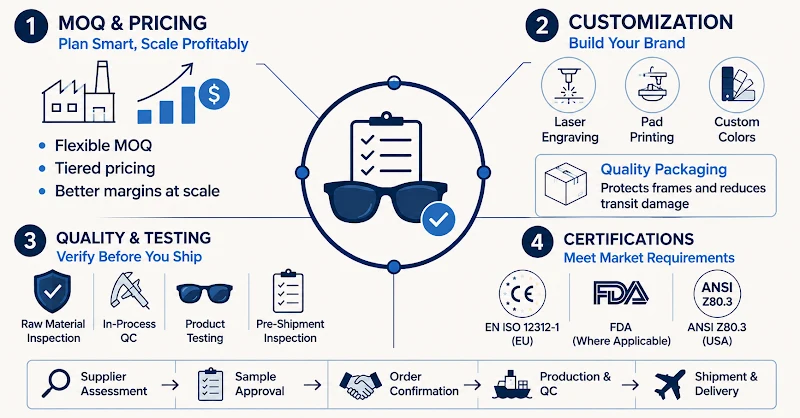
Flexible Minimum Order Quantities (MOQs) allow eyewear brands to test regional markets without overcommitting capital. Vertically integrated factories offer tiered pricing structures that protect operating margins as volumes scale.
Creating brand differentiation requires precise laser engraving, custom pad printing, and durable private-label packaging. Durable packaging prevents frame scratching and high scrap rates caused by crushed boxes during transit.
Buyers should identify the mandatory requirements for each target market and request supporting test reports and conformity documentation from qualified laboratories. Environmental claims such as GRS should be verified separately from product-safety compliance. Where applicable, buyers should verify conformity with the relevant EN ISO 12312-1 requirements for the target European market and ANSI Z80.3 requirements for the U.S. market before shipment.
Partnering with Beautaste Eyewear ensures your brand receives certified, premium kids sunglasses that meet strict international durability standards. Our vertically integrated production supports tighter quality control, consistent production, and more reliable lead-time management.
With over 20 years of manufacturing experience, we help brands optimize design, comfort, and compliance. Contact us today and explore Beautaste custom sunglasses to scale your wholesale operations with confidence.
Yes. Polarized lenses eliminate reflected glare from wet or reflective surfaces, preventing photo stress, squinting, and outdoor eye fatigue.
Children can begin wearing appropriate UV-protective sunglasses at around 6 months of age. Early use can help reduce children’s exposure to solar UV radiation during outdoor activities.
Not necessarily. Price alone does not determine UV protection. Buyers should verify the product’s UV-transmittance performance and applicable compliance documentation rather than relying on appearance or price.

+86-577-86072133

0086 13506515296

 English
 Spanish
 Arabic
 French
 Russian
 Portuguese
 German
 Japanese
 Korean
 Hindi
 Bengali
 Italian
 Turkish
 Persian
 Vietnamese
 Thai
 Urdu
 Dutch
 Indonesian
 Greek
 Swedish
 Malay
 Polish
 Czech
 Tagalog
 Danish




 China
 LIBERIA
 FRANCE
 BARBADOS
 KIRIBATI


